Jackson water crisis: A legacy of environmental racism?
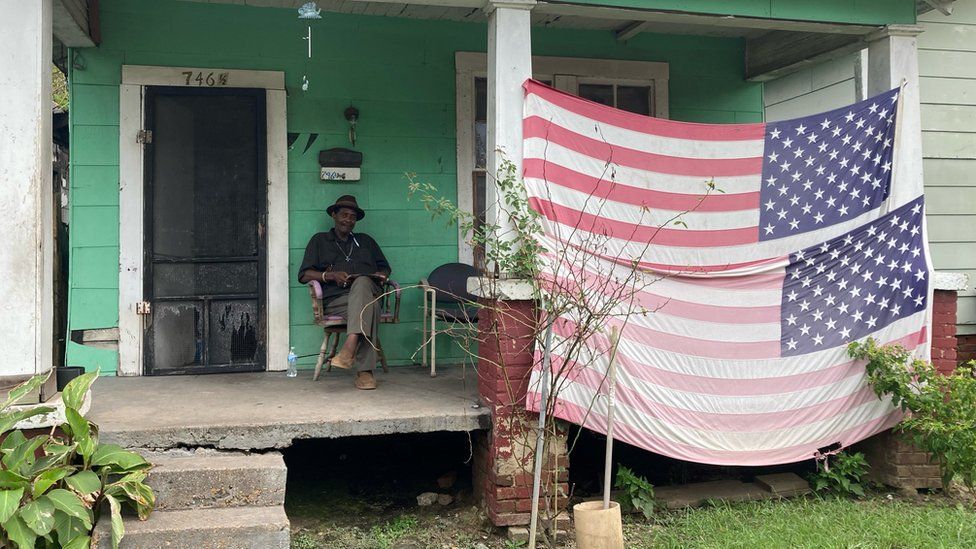
Marshall lives in west Jackson, in the US territory of Mississippi - a transcendently dark and unfortunate area of the city. He must choose the option to drink the faucet water that Jackson inhabitants have been told to keep away from. At the point when he turns the tap on - the water runs brown.
He says this is how things have been for around eight months and he must choose the option to drink it.
"Indeed ma'am. I been drinking it." He grins when we find out if it concerns him. "I turn 70 not long from now," he says.
Marshall doesn't have a vehicle, so he can't get to the destinations where water is being passed out by the National Guard. He likewise doesn't have power or gas due to a new fire in the house nearby, and that implies he can't heat up the water to assist with making it more secure.
"Exceptionally rare it's unadulterated. Now and then it's somewhat lighter, somewhat more obscure. In the bath when I first turn it on, it generally comes out rust, then it gets lighter. Yet, without fail, the rust starts things out."
Jackson councilman Aaron Banks has lived in the Mississippi state's capital for the vast majority of his life, and presently addresses a region that is over 90% Black.
He says he thinks a staggering mix of maturing foundation and environmental change at last prompted the most recent breakdown of Jackson's water supply.
In 2020, while frigid temperatures made Jackson's water treatment office shut down, Mr Banks says his locale did without water for almost a month and a half - far longer than the encompassing regions. The town's framework has battled to keep up from that point forward.
"We have not gone every month without having a 'bubble water' notice or low to no water strain over the most recent two years," he says. "Sadly, that is something we have become acclimated to as American residents - no one ought to adjust that sort of personal satisfaction."
Over and over, Mr Banks says, the individuals who are compelled to adjust have transcendently been minorities. For quite a long time, the councilman says he has watched state subsidizing fill the foundation of towns and regions around Jackson - yet they've missed the offices that need it most, including the city's water treatment plant.
President Joe Biden's milestone foundation bill reserved cash for burdened and underserved networks like Jackson, which in 2020 had a populace of 163,000. Yet, the financing is dispensed by state lawmakers who, Mr Banks says, frequently surrender to governmental issues and focus on projects for their constituents as opposed to zeroing in on fixing foundational issues in Jackson.
"We have a water treatment office that is outdated that no one has contemplated for quite a long time," says Professor Edmund Merem, a metropolitan preparation and ecological examinations teacher at Jackson State University.
"I think the issue is that the response will in general be specially appointed."
However, Prof Merem likewise accepts another component has pulled concentration and subsidizing away from the Jackson's disintegrating framework - race.
Specialists and promoters express out loud whatever is occurring in Jackson - and in towns like Flint in Michigan, where the water supply was debased with lead - is an immediate tradition of ages of separation and isolation.
"This is a well established, long term, in the making sort of circumstance," says Arielle King, a legal counselor and natural equity advocate.
"I think the historical backdrop of racial isolation and redlining in this nation have profoundly added to the ecological shameful acts we see at the present time."
Redlining started during the 1940s as an administration endorsed practice of denying home loans and credits to minorities since they were considered "excessively hazardous."
The program endured over 40 years, and accordingly, Ms King says, low-pay, transcendently African American populations were gathered in regions with contaminating businesses like landfills, petroleum treatment facilities, and wastewater treatment plants.
What's more, those regions, she notes, actually exist today.
She focuses to parts of the nation like supposed Cancer Alley for instance. When the home to Louisiana's rambling ranches, the region along the Mississippi River is presently a modern thruway of in excess of 150 petroleum processing plants and production lines.
For a really long time, the transcendently dark occupants have experienced probably the most elevated paces of malignant growth in the country as a result of contamination.
Ms King says the tradition of this sort of ecological bigotry, combined with many years of underinvestment in low-pay regions is working out in Jackson.
"They can express that there are various elements that lead to flooding, however individuals wouldn't be dependent upon regions that are vulnerable to flooding without redlining in any case," Ms King says.
"So once more, it truly does sort of returned to race, and ecological prejudice, sadly, without fail."
Sarina Larson is examining to be a legal counselor and lives a couple of blocks from Marshall. She moved from Sacramento and needs to be a public guard legal counselor. She also faults redlining for the issues the region has been having.
In her kitchen, there are bowls of fluctuating sizes all around the floor. She gets downpour water in them and afterward utilizes a water channel.
"The lines have lead in them in Jackson thus I could never drink a glass of water," she says. "I don't clean my teeth with the faucet water".
However, she concedes that a great many people can't bear the $300 dollar (£260) channel she purchased.
"A water emergency like this doesn't turn into an issue until it influences individuals of a higher class. It has been continuous and Jackson has been an illustration of that. Individuals' wellbeing is auxiliary to the state."
We met Imani Olugbala-Aziz at a neighborhood public venue where she and others from the worker bunch Cooperation Jackson were giving out filtered water. It took under an hour for them to run out. She lets us know she scarcely has water at her own home.
"It's an emergency of perspectives and values and there's a great deal of ecological bigotry going on. We are sending our cash to the public authority to finish what should be, done. What's more, they're not making it happen.
"We're underserved. Minorities are underserved. We stay in the most awful pieces of town, to make sure we can get by.
"We're not requesting chateaus, we simply need to live and have the ordinary stuff, running water, clean water," Ms Olugbala-Aziz says.
She says the neighborhood a high destitute rate and nearby shops have shut which makes it difficult for individuals to purchase water.
"We've been on the bubbled water alert for about a month. It's not drinkable, so what do we do? How would we take care of our kids, how would we cook and eat?"
Ms Olugbala-Aziz says individuals are covering high water bills, while those in overwhelmingly white regions aren't.
"This isn't something that has simply occurring. This is slow rolling and it has quit wasting time of illogical. We're battling here."



Comments
Post a Comment